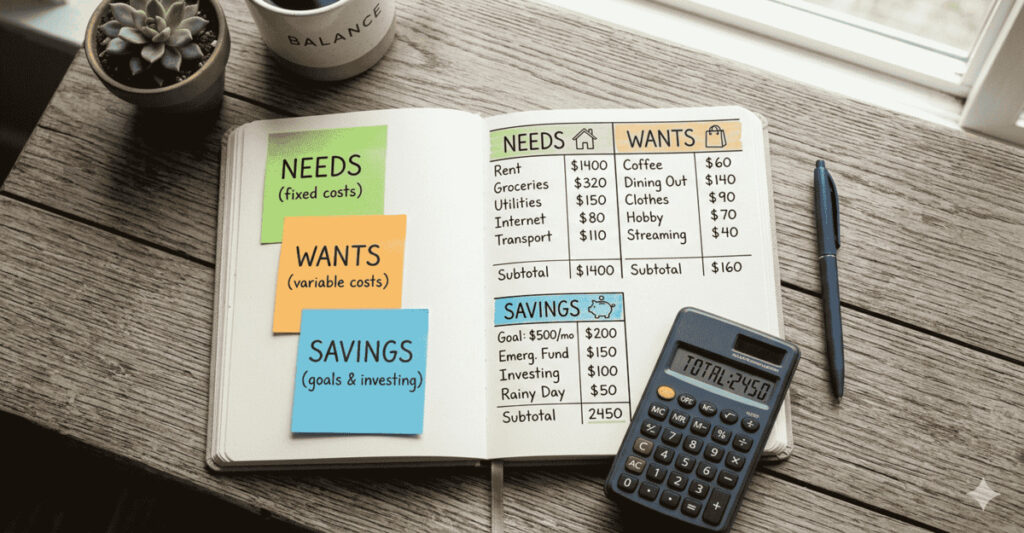
How Expenses Affect Your Budget: Fixed, Variable & Discretionary Expenses Explained (2026)
Every financial decision you make eventually shows up in your budget.
Whether you’re paying rent, buying groceries, subscribing to streaming services, or saving for retirement, every dollar spent affects how much money remains available for your future goals.
While this sounds obvious, many people underestimate how much the type of expense influences their financial flexibility. Some expenses are unavoidable. Others fluctuate month to month. Some are entirely optional.
Understanding how expenses affect your budget means learning to separate your spending into categories and managing each category differently. Once you understand where your money is going, budgeting becomes easier, saving becomes faster, and financial stress becomes significantly lower.
For a complete overview of saving strategies, visit our money saving tips pillar guide.
In this guide, you’ll learn:
- The three major types of expenses
- Fixed vs variable vs discretionary expenses
- How expenses impact your financial goals
- Common spending mistakes
- How to reduce expenses without sacrificing your lifestyle
- The best ways to track spending in 2026
Table of Contents
- What Are Expenses?
- The Three Types of Expenses
- Fixed Expenses Explained
- Variable Expenses Explained
- Discretionary Expenses Explained
- Fixed vs Variable vs Discretionary Comparison
- How Expenses Create Budget Problems
- The Expense Audit Exercise
- How to Reduce Expenses Without Feeling Deprived
- How to Track Monthly Expenses
- Frequently Asked Questions
What Are Expenses?
Expenses are all the costs you incur while living your daily life.
In simple terms: An expense is any money that leaves your account.
Every budget consists of three basic components:
- Income
- Expenses
- Savings
The relationship is simple: Income − Expenses = Savings
The lower your expenses relative to your income, the more money you can save, invest, and use to achieve financial goals. This is why understanding expenses is one of the most important parts of budgeting.
The Three Types of Expenses in a Budget
Most personal finance experts divide expenses into three categories:
- Fixed Expenses
- Variable Expenses
- Discretionary Expenses
Each category affects your budget differently.
1. Fixed Expenses
Fixed expenses remain relatively consistent every month. They are predictable and usually contract-based. Because they do not fluctuate significantly, they are easier to plan for but harder to reduce quickly.
Examples of Fixed Expenses
- Rent or mortgage payments
- Car loan payments
- Student loan payments
- Insurance premiums
- Internet service
- Phone plans
- Childcare fees
- Subscription memberships
How Fixed Expenses Affect Your Budget
Fixed expenses create your financial baseline. They determine the minimum amount of money you must spend every month regardless of your behavior.
For example: if your monthly income is $5,000 and fixed expenses total $2,800, more than half of your income is already committed before the month begins. This limits flexibility when unexpected costs arise — which is why having an emergency fund is so important.
How to Reduce Fixed Expenses
Reducing fixed expenses often requires more effort, but the savings are long-lasting. Strategies include:
- Negotiating rent renewals
- Refinancing loans
- Shopping for cheaper insurance
- Downgrading phone plans
- Canceling unused subscriptions
Even reducing fixed expenses by $100 per month creates $1,200 in annual savings — money that can go straight into a dedicated savings account.
2. Variable Expenses
Variable expenses occur regularly, but the amount changes each month. These expenses are heavily influenced by behavior and habits.
Examples of Variable Expenses
- Groceries
- Gasoline
- Electricity
- Water bills
- Medical costs
- Household supplies
- Personal care products
How Variable Expenses Affect Your Budget
Variable expenses offer the greatest opportunity for gradual savings. Unlike fixed expenses, small habit changes can significantly reduce costs. For example, meal planning lowers grocery bills, driving less reduces fuel costs, and energy-efficient appliances reduce utility bills.
How to Reduce Variable Expenses
- Shop with a grocery list
- Meal prep weekly
- Reduce food waste
- Combine errands
- Use energy-efficient lighting
- Compare prices before purchasing
Consistent improvements can save hundreds of dollars annually — money that compounds powerfully when moved to the right savings account.
3. Discretionary Expenses
Discretionary expenses are optional purchases that improve lifestyle and enjoyment but are not essential for survival. This is also where most overspending occurs.
Examples of Discretionary Expenses
- Dining out
- Coffee shops
- Streaming services
- Entertainment
- Travel
- Hobbies
- Shopping
- Gaming
- Luxury purchases
How Discretionary Expenses Affect Your Budget
Discretionary spending directly competes with savings goals. A single $20 purchase feels insignificant — but ten similar purchases each week become $200 per week, $800 per month, and nearly $10,000 per year.
Many people struggle financially not because of one major purchase but because of dozens of small discretionary expenses. The 50/30/20 budget rule addresses this by capping wants at 30% of income.
Managing Discretionary Spending
Set monthly spending limits. For example:
- Dining Out: $200
- Entertainment: $100
- Shopping: $150
Once the category reaches its limit, spending stops until next month. This creates awareness without eliminating enjoyment.
Fixed vs Variable vs Discretionary Expenses
| Category | Fixed | Variable | Discretionary |
|---|---|---|---|
| Changes Monthly | No | Yes | Yes |
| Essential | Usually | Usually | No |
| Easy to Reduce | No | Moderate | Yes |
| Budget Impact | High | Medium | High |
| Examples | Rent, Loans | Groceries, Utilities | Travel, Dining Out |
Understanding these differences allows you to make smarter budgeting decisions.
How Expenses Create Budget Problems
Problem #1: Lifestyle Inflation
When income increases, spending often increases too — a larger apartment, a new vehicle, more dining out, more subscriptions. As a result, savings remain stagnant despite earning more money.
Solution: Commit at least 50% of every raise toward savings or investments before increasing spending. Our money saving tips guide covers this in detail.
Problem #2: Unexpected Expenses
Many people forget annual expenses such as insurance renewals, holiday gifts, vehicle maintenance, and medical bills. These costs feel like emergencies even though they occur regularly.
Solution: Create a sinking fund and build a solid emergency fund. If annual vehicle maintenance costs $1,200, set aside $100 each month so the cost never catches you off guard.
Problem #3: Subscription Creep
Small recurring charges often go unnoticed. Ten subscriptions averaging $15 per month cost $150 monthly and $1,800 annually.
Solution: Review recurring charges quarterly and cancel unused services. This is one of the fastest money saving tips you can act on today.
The 15-Minute Expense Audit
Before creating a budget, complete this simple exercise.
Step 1: Open the last two months of bank and credit card statements.
Step 2: Label every transaction — Need, Want, or Surprise.
Step 3: Calculate totals for each category.
Step 4: Ask yourself:
- Are surprise expenses above 5% of spending?
- Are wants larger than savings?
- Are there subscriptions I forgot about?
- Are there fixed expenses I can negotiate?
Most people identify immediate savings opportunities within minutes. Once you do, open a dedicated savings account and redirect those funds automatically.
How to Reduce Expenses Without Feeling Deprived
Many budgets fail because they focus on restriction rather than optimization. The goal is intentional spending.
Use the 10% Reduction Method
Reduce discretionary spending by just 10%. On a $500 monthly discretionary budget, that’s $50 per month — or $600 saved annually — without dramatically changing your lifestyle.
Use the Substitution Strategy
Replace expensive habits with lower-cost alternatives:
- Home coffee instead of coffee shops
- Cooking instead of takeout
- Local travel instead of expensive vacations
You maintain enjoyment while spending less — and the savings can go toward your emergency fund or investments.
Follow the 48-Hour Rule
For purchases above $100, wait 48 hours. Many impulse purchases lose their appeal after a short delay. This is one of the simplest yet most powerful tips from our money saving tips guide.
How to Track Monthly Expenses
You cannot improve what you do not measure. Choose one system and use it consistently.
Method 1: Spreadsheet Tracking
Simple columns — Date, Description, Amount, Category — give you maximum control and a clear picture of where every dollar goes.
Method 2: Budgeting Apps
Apps automatically categorize spending and provide insights. Best for convenience and those new to budgeting.
Method 3: Monthly Statement Review
Download statements once per month and categorize transactions manually. Many people find this provides the best balance between effort and awareness, especially when paired with the 50/30/20 budget rule to check if spending is on track.
Frequently Asked Questions
What are the three main types of expenses?
Fixed expenses, variable expenses, and discretionary expenses. Each affects your budget differently and requires a different management strategy.
Which expenses should I reduce first?
Start with discretionary expenses because they are optional and easiest to control.
How often should I review my expenses?
At least monthly. Weekly reviews can help maintain awareness. Always compare against your 50/30/20 budget targets.
What is the difference between fixed and variable expenses?
Fixed expenses remain consistent each month. Variable expenses fluctuate based on usage and behavior. Both are covered in our full expenses definition guide.
Can reducing expenses really improve savings?
Absolutely. Reducing spending by just $250 per month creates $3,000 in annual savings. Move that money straight into a large bank savings account to maximize returns.
Final Thoughts
Understanding how expenses affect your budget is one of the most valuable personal finance skills you can develop. When you categorize expenses correctly, track spending consistently, and make intentional decisions about where your money goes, budgeting becomes far easier and financial goals become much more achievable.
Remember:
- Fixed expenses determine your baseline.
- Variable expenses provide flexibility.
- Discretionary expenses offer the biggest opportunities for savings.
Master these three categories and you’ll gain greater control over your money, reduce financial stress, and build a stronger financial future throughout 2026 and beyond.
Ready for the next step? Explore our complete Money Saving Tips pillar guide for 25 proven strategies to help you spend smarter, save more, and build long-term wealth.

Mohamed Faisal writes about money management, investing, and personal finance tools that help people grow their wealth.