Published: July 9, 2026 | Last Updated: July 9, 2026 | Reviewed by: Axion Report Editorial Team – Personal Finance Experts
⚠️ Disclaimer – YMYL / Personal Finance Education: This content is for educational and informational purposes only and does not constitute financial, tax, or legal advice. Expense tracking, budgeting strategies, and savings recommendations are based on widely accepted personal finance principles but may not apply to every individual situation. Always consult a certified financial planner or tax professional for personalized guidance. Axion Report may earn affiliate commissions from financial products or platforms at no additional cost to you. This does not influence our editorial independence or recommendations.
Expenses Definition: What Are Expenses in Personal Finance? Types, Examples & Categories Explained (2026)
Understanding expenses is one of the most important steps toward improving your financial health.
Whether you’re creating your first budget, trying to save more money, paying off debt, or planning long-term financial goals, you need to understand exactly what expenses are and how they impact your finances.
Many people know how much they earn each month but have only a vague idea where their money actually goes. That gap creates financial stress, overspending, and difficulty reaching savings goals.
In simple terms: An expense is any money you spend.
Every dollar that leaves your bank account, wallet, credit card, or digital payment app is an expense. For the full picture of how to manage your money, visit our complete money saving tips pillar guide.
Table of Contents
- What Is an Expense?
- Expenses Definition in Personal Finance
- Why Expenses Matter
- Main Types of Expenses
- Essential vs Non-Essential Expenses
- Fixed Expenses
- Variable Expenses
- Irregular Expenses Explained
- Household Expense Categories
- Expenses vs Bills vs Costs
- How Expenses Affect Your Budget
- How to Track and Categorize Expenses
- Expenses and Your Savings Rate
- Common Expense Mistakes
- Frequently Asked Questions
What Is an Expense?
An expense is any cost incurred when purchasing goods, services, or meeting financial obligations. In personal finance, expenses represent money flowing out of your household.
Examples include:
- Rent or mortgage payments
- Grocery shopping
- Utility bills
- Transportation costs
- Insurance premiums
- Entertainment purchases
- Healthcare expenses
- Subscription services
Every financial plan begins with understanding these outgoing costs. Without knowing your expenses, it is impossible to create an accurate budget or savings plan.
📌 Expert insight: According to the Bureau of Labor Statistics’ Consumer Expenditure Survey (2025), the average U.S. household spends approximately $73,000 annually — with housing (33%), transportation (16%), and food (13%) representing the three largest expense categories.
Expenses Definition in Personal Finance
Expenses are the costs you pay to live, work, and manage your daily life. They include both necessities and optional spending.
In personal finance, expenses represent the “outflow” side of your money. The basic financial equation looks like this:
Income − Expenses = Savings
If your expenses are lower than your income, you generate savings — ideally directed into a dedicated savings account. If expenses exceed income, you create a deficit and may need to borrow money or use credit.
This is why expenses are one of the most important numbers in your financial life. According to the Federal Reserve’s 2025 Survey of Household Economics, 37% of U.S. adults would struggle to cover a $400 unexpected expense — a direct consequence of insufficient expense awareness and lack of emergency savings.
Why Expenses Matter
Every financial goal depends on controlling expenses. Whether you want to build an emergency fund, save for a house, pay off debt, invest for retirement, or increase financial security — you must understand where your money goes first.
People often focus heavily on earning more income. While increasing income helps, reducing unnecessary expenses often produces immediate results.
For example: a person earning $5,000 monthly and spending $4,800 saves only $200. Reducing expenses by just $300 increases savings by 150%. Small expense reductions can create major long-term financial improvements — a key theme throughout our money saving tips guide.
Main Types of Expenses
Personal expenses generally fall into five major categories:
- Essential Expenses
- Non-Essential Expenses
- Fixed Expenses
- Variable Expenses
- Irregular Expenses
1. Essential Expenses (Needs)
Essential expenses are costs required to maintain a basic standard of living. Failing to pay them would create serious consequences.
Examples of Essential Expenses
- Rent or mortgage payments
- Basic groceries
- Electricity and water bills
- Transportation to work
- Health insurance
- Minimum debt payments
- Childcare expenses
- School fees
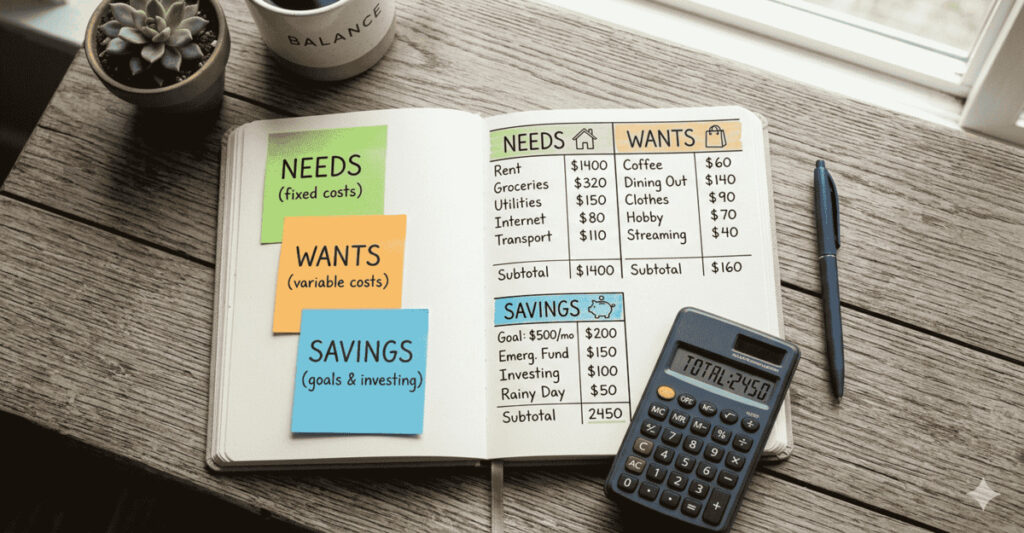
These expenses should be prioritized in every budget. Many budgeting experts recommend keeping essential expenses below 50% of take-home income — exactly what the 50/30/20 budget rule prescribes.
2. Non-Essential Expenses (Wants)
Non-essential expenses improve your lifestyle but are not necessary for survival. These expenses provide comfort, convenience, and enjoyment.
Examples of Non-Essential Expenses
- Restaurant meals
- Food delivery
- Streaming services
- Vacations
- Gaming subscriptions
- New gadgets
- Designer clothing
- Entertainment events
Most overspending occurs in this category because individual purchases often seem small. The 50/30/20 rule caps wants at 30% of income to keep this spending under control.
3. Fixed Expenses
Fixed expenses remain relatively consistent every month. They are predictable and easy to budget for.
Examples of Fixed Expenses
- Rent
- Mortgage payments
- Car loans
- Insurance premiums
- Internet service
- Tuition fees
- Subscription memberships
Fixed expenses create your spending baseline. The higher your fixed costs, the less flexibility you have when income drops or emergencies occur — making a strong emergency fund even more essential. For a deeper look, read our guide on how expenses affect your budget.
4. Variable Expenses
Variable expenses occur regularly but fluctuate based on behavior and usage.
Examples of Variable Expenses
- Groceries
- Fuel
- Electricity
- Water bills
- Household supplies
- Medical expenses
- Personal care items
Variable expenses are where many people can make meaningful savings without dramatically changing their lifestyle — through meal planning, reducing food waste, conserving electricity, and comparing prices before purchases. Small changes often produce significant annual savings that can be redirected to a savings account.
5. Irregular Expenses
Irregular expenses occur occasionally rather than every month. Because they are infrequent, many people forget to budget for them.
Examples of Irregular Expenses
- Vehicle repairs
- Car insurance renewals
- Medical procedures
- Home maintenance
- Holiday gifts
- School supplies
- Passport renewals
- Travel expenses
Smart Budgeting Tip
Add all annual irregular expenses together. For example: vehicle maintenance ($600) + holiday gifts ($600) + insurance renewal ($1,200) = $2,400 annually, or $200 per month. Set aside $200 monthly in a separate savings account. When the expense arrives, the money is already available — no need to dip into your emergency fund.
Household Expense Categories
Organizing expenses into categories makes budgeting significantly easier.
Housing: Rent, mortgage, property taxes, home insurance
Food: Groceries, dining out, food delivery
Transportation: Fuel, vehicle payments, public transit, parking
Utilities: Electricity, water, gas, internet, mobile phone service
Healthcare: Insurance, prescriptions, doctor visits
Education: Tuition, books, online courses
Entertainment: Movies, streaming services, hobbies
Financial Obligations: Credit cards, personal loans, student loans
Savings & Investments: Emergency fund contributions, retirement accounts, investment accounts
Expenses vs Bills vs Costs
| Term | Meaning |
|---|---|
| Expense | Any money spent |
| Bill | An expense that requires payment after receiving an invoice |
| Cost | The amount paid for a product or service |
For budgeting purposes, all three represent money leaving your account.
How Expenses Affect Your Budget
Every expense reduces money available for saving and investing. The relationship is simple: Higher Expenses = Lower Savings. Lower Expenses = Higher Savings.
| Monthly Income | Monthly Expenses | Savings |
|---|---|---|
| $5,000 | $4,500 | $500 |
| $5,000 | $4,000 | $1,000 |
| $5,000 | $3,500 | $1,500 |
Even modest reductions can dramatically improve financial outcomes. For a complete breakdown, read our guide on how expenses affect your budget, which covers fixed, variable, and discretionary spending in detail.
How to Track and Categorize Expenses
Follow this simple process:
- Download the last three months of bank and credit card statements.
- Create categories based on the household list above.
- Assign every transaction to a category.
- Calculate monthly averages.
- Compare spending against income using the 50/30/20 rule as a benchmark.
- Identify categories that can be reduced.
Most people discover spending leaks immediately after completing this exercise. According to a 2025 study by the National Endowment for Financial Education, individuals who track expenses weekly are 45% more likely to report feeling in control of their finances compared to those who track monthly or less frequently.
Expenses and Your Savings Rate
Your savings rate depends entirely on the gap between income and expenses.
| Income | Expenses | Savings | Savings Rate |
|---|---|---|---|
| $5,000 | $4,500 | $500 | 10% |
| $5,000 | $4,000 | $1,000 | 20% |
| $5,000 | $3,000 | $2,000 | 40% |
Improving your savings rate requires either increasing income or reducing expenses. Reducing expenses usually delivers results faster. Compare large bank savings accounts to make sure every dollar you save is working as hard as possible.
Common Expense Mistakes
Many people struggle financially because of a few common mistakes:
Not Tracking Spending: You cannot control what you do not measure. A proper budget starts with tracking every expense.
Ignoring Small Purchases: Small recurring expenses often become large annual costs. A $5 daily coffee adds up to $1,800 per year — enough to fully fund a Roth IRA contribution. Our money saving tips guide covers the best ways to catch these leaks.
Forgetting Irregular Expenses: Annual expenses should be planned monthly using the sinking fund method described above.
Keeping High Fixed Costs: Large recurring obligations reduce financial flexibility. Learn how expenses affect your budget to identify which fixed costs to tackle first.
Lifestyle Inflation: Spending increases every time income rises. Successful budgeting requires avoiding this trap. Financial experts recommend saving at least 50% of any raise to prevent lifestyle creep from eroding your savings rate.
Frequently Asked Questions
What is the definition of expenses?
Expenses are any money spent on goods, services, obligations, or lifestyle costs. They are the outflow side of your personal finance equation: Income − Expenses = Savings.
What are examples of expenses?
Rent, groceries, transportation, insurance, utilities, healthcare, entertainment, and debt payments. See our how expenses affect your budget guide for a full breakdown by category.
What is the difference between fixed and variable expenses?
Fixed expenses stay consistent each month, such as rent or loan payments. Variable expenses change depending on usage and behavior, such as groceries and fuel. According to the Bureau of Labor Statistics, the average U.S. household allocates approximately 60% of spending to fixed expenses and 40% to variable expenses.
Why should I track expenses?
Tracking expenses helps you budget effectively, identify overspending, increase savings, and reach financial goals faster — including building a solid emergency fund. Research shows that consistent expense trackers save 20% more annually than non-trackers.
What are irregular expenses?
Expenses that occur occasionally rather than monthly, such as vehicle repairs, insurance renewals, vacations, or holiday gifts. Budget for them monthly using a sinking fund to avoid financial surprises.
How much should I budget for essential expenses?
Financial experts recommend keeping essential expenses (needs) below 50% of your take-home pay, as outlined in the 50/30/20 budget rule. If your essentials exceed 50%, review fixed costs like housing and transportation for reduction opportunities.
Final Thoughts
Understanding the expenses definition is one of the foundational concepts of personal finance. Every financial goal — whether it’s building an emergency fund, becoming debt-free, saving for a home, or investing for retirement — starts with understanding where your money goes.
By categorizing expenses correctly, tracking spending consistently, and reviewing your budget regularly, you gain greater control over your finances and create more opportunities to save and build wealth over time.
The more awareness you have of your expenses today, the stronger your financial future will be tomorrow. For 25 proven strategies to cut expenses and save more, return to our complete Money Saving Tips pillar guide.
Disclaimer: This content is for educational purposes only and does not constitute financial advice. Always consult a qualified financial advisor before making financial decisions.

Mohamed Faisal writes about money management, investing, and personal finance tools that help people grow their wealth.